
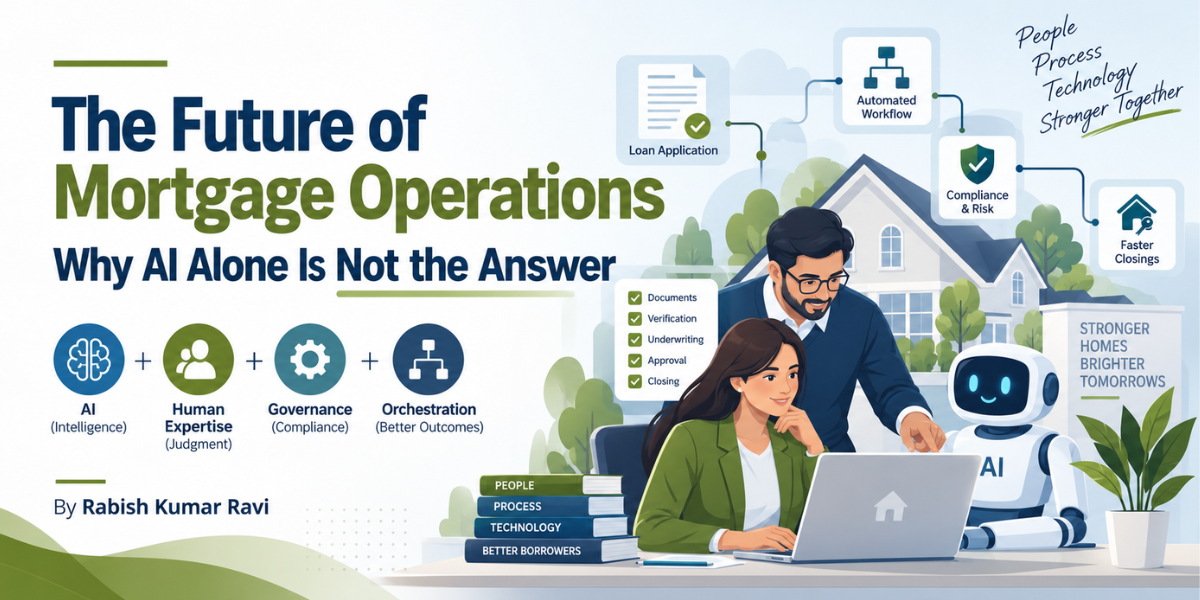
By Rabish Kumar Ravi
Mortgage operations, technology, compliance, and business leaders have spent years funding digital transformation initiatives. Yet many lenders, servicers, and mortgage service providers continue to wrestle with familiar problems: fragmented systems, manual handoffs, compliance complexity, rising operational costs, and borrowers who expect more than the industry typically delivers.
As artificial intelligence becomes part of everyday mortgage operations, many organizations are asking a narrow question: “How can we implement AI?” A more useful question is: “How can AI improve the borrower, employee, and operational experience?”
The distinction matters. Technology alone rarely solves business problems. Well-designed processes, backed by the right technology and the right governance, do.
Mortgage Is Not a Transaction. It’s a Journey.
A typical mortgage transaction touches multiple systems, vendors, teams, regulators, documents, and decision points. Borrowers rarely care how many systems are involved behind the scenes. They care about:
Consider a common origination scenario: a borrower submits a bank statement that doesn’t match the income stated on their application. In a disconnected environment, that discrepancy might sit in a processor’s queue for days before anyone notices, triggering a manual email to the borrower, a delay in underwriting, and a frustrated loan officer fielding “what’s the status?” calls. None of the individual systems failed — the loan origination system (LOS), the point-of-sale portal, and the document management system all did their job. What failed was the connective tissue between them.
That connective tissue — orchestration, real-time status visibility, and automation across origination and servicing — is where many organizations still fall short, and where the industry’s attention is increasingly turning.
AI’s Greatest Opportunity Is Reducing Friction, Not Headcount
Conversations about AI in mortgage often start with automation: replacing manual tasks. That’s a legitimate use case. AI is already being applied to document classification and extraction, income and asset analysis, underwriting support, compliance monitoring, borrower communication, and due diligence review.
Adoption is accelerating. A 2025 Stratmor Group survey found that 38% of mortgage lenders reported using artificial intelligence and machine learning in 2024, up from just 15% in 2023.1 On the broker side, AD Mortgage’s 2026 industry survey found that 55% of brokers now use AI daily or regularly, and 72% expect significant growth in AI use over the next three years.
But volume of adoption isn’t the same as depth of value. In underwriting, for example, AI tools that reconcile pay stubs, tax transcripts, and bank statements can cut the hours a processor spends manually cross-referencing income documentation — not by replacing the underwriter’s judgment on borderline files, but by clearing the straightforward files faster so the underwriter’s time goes to the exceptions that actually need it. In due diligence, AI-assisted document review can flag missing conditions or inconsistent data across a loan file before it reaches a reviewer, rather than relying solely on manual sampling.
The larger opportunity is friction reduction. Every time a borrower waits for an update, an employee re-keys information between systems, or a processor searches for a document that already exists somewhere in the file, organizational capacity is being wasted. Viewed this way, AI is a capability for removing friction — not primarily a headcount lever.
The Rise of the Digital Borrower — With a Caveat
Today’s borrowers compare their mortgage experience not just against other lenders, but against Amazon, Uber, and their own banking apps. Many expect mobile-first experiences, real-time updates, self-service portals, and transparency throughout the process.
That expectation, however, comes with a tension worth naming: borrower trust in AI is not uniform, and recent data suggests it may be softening as AI becomes more visible in the process. Cotality’s 2026 AI in Housing research found that consumer trust in AI for the home-buying process dropped from 30% in 2025 to 16% in 2026.3 The lesson is not to avoid AI-enabled borrower experiences, but to be deliberate about where AI is visible to the borrower, where it should stay invisible, and where a human still needs to be clearly in the loop — particularly around decisions that affect approval, pricing, or terms.
Organizations that combine proactive status updates, self-service tools, and clear disclosure about how AI is used are more likely to build durable trust than those that simply layer AI onto an unchanged process.
Why Human Expertise Still Matters
A common misconception is that AI will eventually replace mortgage professionals. That’s unlikely for reasons that are as much regulatory as they are practical.
Mortgage transactions remain highly regulated and operationally complex, and increasingly, regulators are making human accountability an explicit requirement rather than an assumption. The CFPB’s Circular 2026-03, issued May 5, 2026, reaffirmed that lenders using complex algorithms such as machine-learning underwriting models remain fully responsible under ECOA and Regulation B for providing specific, accurate reasons for adverse action — and that proprietary or “uninterpretable” models do not excuse compliance.4
In practice, this means:
The organizations gaining the most from AI tend to treat it as a co-pilot rather than a replacement: AI handles repetitive, high-volume work and surfaces information faster, while people retain responsibility for judgment calls, escalation, and borrower relationships. This human-in-the-loop model is not just good practice — for many use cases, it is now a documented regulatory expectation.
Governance Is Becoming a Competitive Differentiator
As AI adoption grows, regulators, GSEs, and investors are paying closer attention to how it’s governed, not just how fast it’s deployed. Several developments in 2026 make this concrete rather than aspirational:
Taken together, these frameworks point to a consistent set of governance priorities that mortgage organizations should build into any AI initiative, not bolt on afterward:
None of this is about slowing AI adoption. It’s about building the kind of documentation and oversight that lets an organization scale AI with confidence — and defend its decisions when asked to.
The Next Era: Orchestrated Mortgage Operations
Mortgage orchestration is a term that gets used loosely, so it’s worth defining plainly: orchestration is the coordination layer that connects data, workflows, people, AI models, and customer interactions into a single, event-driven process — rather than a collection of point solutions that each solve one part of the loan lifecycle in isolation. Effective mortgage technology solutions help connect these capabilities across origination, processing, underwriting, closing, and servicing. A loan origination system, a document management tool, and an AI underwriting assistant can each work well individually and still produce a fragmented borrower experience if nothing coordinates the handoffs between them.
Orchestration is what changes that. Consider the borrower document scenario again, but this time with orchestration in place: a borrower uploads a bank statement. The document is automatically classified and the relevant data extracted. Business rules run to check it against the application. If the numbers match, the condition clears automatically and the borrower gets a status update without anyone touching the file. If they don’t match, the discrepancy is routed to the right person — not a generic queue — with the context already assembled, and the borrower is told what’s happening and why.
That is a materially different experience from manual review, email chains, and status-check calls, even though every individual capability (classification, extraction, rules, notification) may already exist in the organization’s technology stack. The value comes from connecting them.
Practical Steps for Mortgage Organizations
Moving from point solutions to a coordinated, well-governed AI strategy doesn’t require a single large transformation program. A few practical starting points:
Final Thought
The mortgage industry is at a pivotal point. Organizations can continue optimizing fragmented processes, or they can reimagine the mortgage journey end to end.
AI is not the destination. Better borrower experiences, empowered employees, stronger compliance, and more scalable operations are the destination. AI — deployed with clear governance and real human oversight — is one of the vehicles that can help get there.